
A combative billionaire commodity trader and a nation at the center of a political storm in the Middle East are about to join the board of Russia’s largest oil producer. They’ll feel right at home.
The current directors of Rosneft PJSC, which pumps more oil than any other traded company, are already well versed in political intrigue or bare-knuckle business practices. They range from veterans of oil giants BP Plc and Exxon Mobil Corp., to Cold Warriors such as former East German Stasi agent Mattias Warnig and Igor Sechin, a long-time ally of President Vladimir Putin.
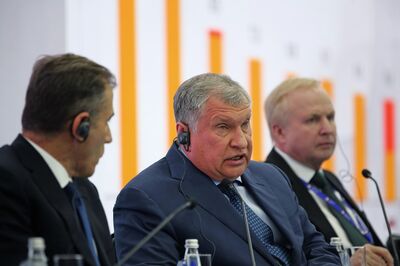
On Thursday they will be joined by Glencore Plc Chief Executive Officer Ivan Glasenberg, who built the world’s largest commodity trader, and Faisal Alsuwaidi, who oversaw Qatar’s development into a global gas giant before taking on his current role as president of research and development at the non-profit Qatar Foundation.
The new additions to the board follow the joint acquisition of almost 20 percent of the Russian oil producer by Glencore and Qatar’s sovereign wealth fund last year. In return for its part of that $11-billion investment, the tiny Middle Eastern nation joins the oil club led by Rosneft CEO Sechin, bolstering its alliance with the Kremlin as Saudi Arabia and its allies sever economic and diplomatic ties.
For Glasenberg, taking a seat at the top table of Russian energy shows that Glencore’s comeback is complete. Rosneft was his first big acquisition since the company’s 2015 crisis, when its shares collapsed due to concerns it wouldn’t be able to repay debt. Peter Grauer, the chairman of Bloomberg LP, is a senior independent non-executive director at Glencore.
The shifting makeup of Rosneft’s board will not change how it’s governed and all major decisions will still be made in the Kremlin, which retains a controlling stake, according to Vladimir Milov, an opposition politician who formerly served as Deputy Energy Minister. Still, the new directors may bring business opportunities, said Artem Konchin, an oil analyst at Otkritie Capital.
“Oil traders are there for one reason, BP and ExxonMobil for another,” Konchin said. “We may see more ‘enablers’ on board in the future — characters who can help it enlarge its footprint in South Asia or develop the liquefied natural gas business.”
At the very least, Rosneft’s conference table makes for interesting company:
Igor Sechin
The most powerful man in the Russian oil industry started his career as a Soviet Army translator in Cold War hot spots Mozambique and Angola. He later worked under Putin in the St. Petersburg Mayor’s Office, following him to the Kremlin where he became deputy chief of staff and later deputy prime minister. With the backing of the state, Sechin turned Rosneft into an energy giant by acquiring the bulk of the Yukos assets the government seized from jailed tycoon Mikhail Khodorkovsky, then buying BP’s Russian joint venture in 2013 and Bashneft last year.
Alexander Novak
Energy minister since 2012, Novak represented Russia in negotiations leading up to the historic agreement last year to cut oil production in tandem with the Organization of Petroleum Exporting Countries. He worked closely with his Saudi counterpart Khalid Al-Falih, finalizing the deal with a late night phone call and sitting alongside him at the head of the conference room at OPEC’s last meeting in Vienna — a testament to Russia’s leadership of a group that pumps more than half the world’s crude.
Matthias Warnig
Warnig worked until 1989 as an agent for the Stasi, the state security service of communist East Germany, the same period that Putin served as a KGB officer in the country. The former head of Dresdner Bank AG for Russia, he’s had dealings with the Russian president since at least 1991, when he was seeking to open a bank representative office in St. Petersburg. Warnig was managing director of the Nord Stream natural gas pipeline that connects Russia to Germany from 2006 to 2016 and currently serves on the boards of VTB Bank PJSC, Transneft PJSC and United Co. Rusal.
Robert Dudley
BP’s CEO has plenty of experience with the tough-end of the oil business. He ran the TNK-BP joint venture until 2008, when he was forced to flee Russia amid a dispute with the company’s Soviet-born billionaire partners. After a short stint overseeing BP’s American operations, in 2010 he was drafted in to run the whole company as the Deepwater Horizon oil spill spiraled into an existential crisis. After calming the situation in the Gulf of Mexico, his return to Russia in 2011 brought renewed conflict as the TNK-BP partners sought to block an Arctic exploration deal with Sechin’s Rosneft. That dispute eventually led to the sale of the company to Rosneft, in return for which BP gained a near 20 percent stake in the Russian producer.
Andrey Akimov
The CEO of Gazprombank, Russia’s third largest, rose to prominence in the final months of the Soviet Union in 1991, when he was part of a group dispatched to the U.S. in search of investment by the nation’s leader Mikhail Gorbachev. Later that year, Akimov got permission from the Politburo to set up IMAG GmbH in Vienna — a business intended to facilitate trade with Europe. That company would later help a trader called Gennady Timchenko get a foothold in the oil business, a venture that would turn him into a billionaire and lead to the creation of Gunvor Group Ltd., one of the world’s largest energy traders. In 2006, Gazprombank helped Rosneft fund the takeover of Yukos assets.
The rest of the board include Chairman Andrey Belousov, a career government economist, Oleg Vyugin, the former head of Russia’s financial markets service, Guillermo Quintero, the former head of BP’s Brazilian unit and Donald Humphreys, who was Exxon’s chief financial officer until 2013.
Courtesy Bloomberg







