
Business A.M
No Result
View All Result
Saturday, October 17, 2026
  • Login
  • Technology
  • Finance
  • Comments
  • Companies
  • Commodities
  • ONLINE & DIGITAL CONTENT PACKAGE
Subscribe
Business A.M
  • Technology
  • Finance
  • Comments
  • Companies
  • Commodities
  • ONLINE & DIGITAL CONTENT PACKAGE
No Result
View All Result
Business A.M
No Result
View All Result
Home Africa Nigeria

Hedge fund manager Hart finally gives up on China bet after he lost millions

by Admin
September 7, 2017
in Nigeria

Mark Hart, an investor spent seven years and $240 million waiting on a crash in China’s currency.

According to Bloomberg, he lost sleep. He lost clients. He almost lost his sanity.

And now he’s lost his conviction: Hart, who called for a more than 50 percent yuan devaluation last year, has turned bullish on China and its currency.

His reversal hasn’t come easily. From his base in Fort Worth, Texas, the hedge fund manager spent countless nights on the line to Hong Kong, parsing market news and exchange rates. At times, the stress took a toll on Hart personally and left his employees demoralized.

“I always thought we had a good risk-reward trade on, but we made a number of mistakes, including being way too early,” Hart, who started the yuan bet after predicting both the U.S. subprime mortgage bust and the European debt crisis said in a telephone interview. “And now the world has changed.”

In cool hindsight, the 45-year-old founder of Corriente Advisors sees last year’s Group of 20 summit in Shanghai as a key turning point. Like many investors, Hart suspects the meeting resulted in a tacit agreement among world leaders to prevent the yuan from tumbling. He calls it China’s “whatever it takes” moment — when policy makers resolved to prop up the currency at any cost.

“China now has the breathing room it needs to either temporarily stave off a slowdown with fiscal and monetary stimulus, or reform, grow and upgrade itself into the world’s largest developed economy,” Hart said.

Whether or not China got help from other G-20 nations, the government has clearly succeeded in stabilizing the exchange rate. The yuan ended a three-year slide in late December and has rallied almost 7 percent in 2017, including a 0.5 percent increase on Thursday. It’s now trading at the strongest level in more than a year versus the greenback.
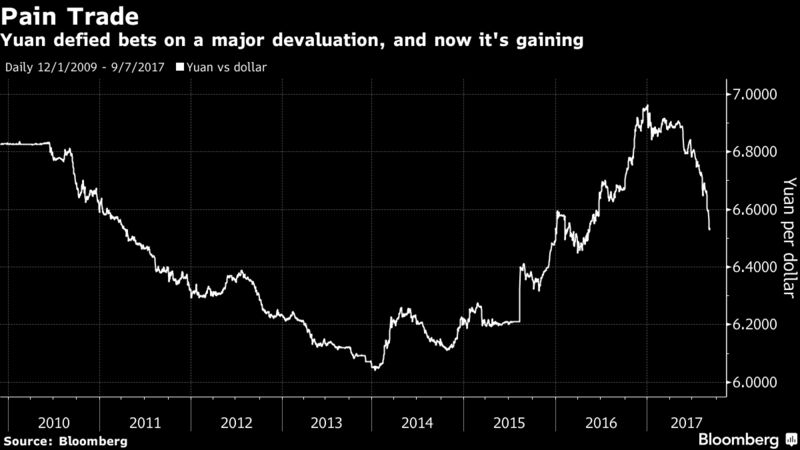
Even at its weakest point, the yuan never dropped enough to move the needle on Hart’s wager, which started in 2009. His dedicated China funds, which had fixed lifespans, bought options that were designed to deliver one of two outcomes: a massive payoff in the event of a currency crash, or a near total wipeout if a major devaluation failed to occur.

The trade went against him almost from the beginning. After holding steady for the first six months of 2010, the yuan strengthened for the next three and a half years. It eventually reversed course, but the sharp devaluation that Hart had anticipated never materialized. His second China fund shut in December. All told, he lost between $240 million and $250 million.

In an interview with Bloomberg Markets last year, Hart said his biggest mistake was believing that China’s leaders would find it in the country’s best interest to let the yuan slide (a one-off devaluation, Hart argued, would remove an incentive for capital outflows). Instead, policy makers went to extreme lengths to prop up the currency, tightening capital controls and burning through more than $800 billion of foreign-exchange reserves over the past two years.

For Hart, it was a rare miscalculation. His macro hedge fund had returned an annualized 30 percent from 2001 through 2006, while his wagers against the U.S. mortgage market gained six-fold during the global financial crisis. Hart then doubled some of his investors’ money by predicting the European sovereign debt crisis that ensued.

He wasn’t the only hedge fund manager to forecast a yuan crash. Hayman Capital Management’s Kyle Bass, who worked with Hart on the subprime mortgage bet, called for a 30 percent devaluation in February 2016, while Passport Capital’s John Burbank said three months later that he expected a “major” slump within a year. Managers from David Tepper to Crispin Odey made similar predictions in 2015.

While some hedge funds have stuck with their bearish wagers, Hart says the tide has turned in China’s favor. Foreign central banks and institutional investors are adding to their yuan holdings as the country steadily integrates itself with the global financial system, while President Xi Jinping’s “One Belt, One Road” initiative has allowed China to strengthen ties with trading partners across Asia, Europe, the Middle East and Africa.

Hart says Beijing’s capital controls, including a clampdown on overseas acquisitions, have proven very effective.

“I don’t expect to see many big soccer club purchases by wealthy Chinese,” he said, adding that outbound investments will generally be directed toward the technology industry and the “One Belt, One Road” project.

Record corporate debt levels are still a challenge, but Hart says China is starting to reap the benefits from its “world class” infrastructure and burgeoning tech sector. He’s optimistic about stocks in both of those industries, as well as other emerging Asian nations, Japan and southern Europe, though he declined to talk about specific investments and his fund.

As for the yuan, Hart says he’s not trading the currency — at least for now.


Report courtesy Bloomberg

Admin
Admin
Previous Post

Nigeria’s central bank roles out regulatory framework for short code providers to curb risks in electronic payment systems

Next Post

Nigeria equities market posts yet another bull performance as market cap adds N175bn

Next Post

Nigeria equities market posts yet another bull performance as market cap adds N175bn

  • Trending
  • Comments
  • Latest

How UNESCO got it wrong in Africa

May 30, 2017

CBN to issue N1.5bn loan for youth led agric expansion in Plateau

July 29, 2025
MMA2 enters new commercial era after 20-year concession dispute

MMA2 enters new commercial era after 20-year concession dispute

August 28, 2026
NGX taps tech advancements to drive N4.63tr capital growth in H1

Insurance-fuelled rally pushes NGX to record high

August 8, 2025

6 MLB teams that could use upgrades at the trade deadline

Top NFL Draft picks react to their Madden NFL 16 ratings

Paul Pierce said there was ‘no way’ he could play for Lakers

Arian Foster agrees to buy books for a fan after he asked on Twitter

Methane rules spread across 67% of global production as Nigeria faces compliance test 

Methane rules spread across 67% of global production as Nigeria faces compliance test 

October 17, 2026
Onafriq, a pan-African payments company, is set to discontinue its Baxi agent banking business in Nigeria after five years, citing naira depreciation, rising operating costs and intensifying competition that have weakened the segment’s profitability. The planned shutdown will affect the agent banking operations conducted through Baxi under Onafriq Nigeria Payments Limited. However, the decision does not signal the company’s withdrawal from Nigeria, as it intends to retain its cross-border payments network and card issuing services in the country. In a statement, Onafriq said changes in Nigeria’s operating environment since 2024 had significantly altered the economics of its offline agent banking business, making the existing model unsustainable. The move marks a strategic shift for the company, which entered Nigeria’s agent banking market to expand access to financial services through a network of agents providing transaction services outside traditional bank branches. Onafriq attributed the decision to a combination of macroeconomic pressures and structural changes in the country’s payments industry. According to the company, naira depreciation and inflation have affected transaction volumes, increased operating expenses and undermined the sustainability of its agent banking operations. The growing adoption of instant account-to-account transfers has also changed the mix of transactions handled by agents, while heightened competition among payment service providers has put further pressure on margins. These developments have made it increasingly difficult for the business to remain viable under its existing operating structure, prompting the company to reassess its long-term strategy. Dare Okoudjou, founder and chief executive officer of Onafriq, said the decision to close the business was difficult, particularly given the efforts of employees, agents and business partners who helped build the Baxi network. “We entered Nigeria with conviction and commitment, but did not achieve the outcome we set out for. Closing this business was a difficult decision to arrive at, one that affects colleagues, agents, and business partners across Nigeria who poured their hearts and soul into building out the Baxi network,” Okoudjou said. Despite the closure, he reaffirmed the company’s commitment to the Nigerian market, noting that the group would continue to serve customers through its payments network and card issuing operations. Onafriq entered Nigeria’s agent banking market in 2021 through the acquisition of Baxi, also known as Capricorn Digital Limited. The company said it continued investing in the business through 2023, with efforts focused on expanding and strengthening its agent network. However, a subsequent review of the business’s long-term prospects and financial sustainability led to the decision to wind down the operation. As part of the transition, Onafriq said agents onboarded through the Baxi platform had been moved to another principal bank, a step intended to facilitate continuity for the affected agents. The company has also directed agents to transfer their funds to their preferred principal bank within 30 days, adding that its teams would provide support throughout the transition process. Employees whose roles are linked to the agent banking business will also be consulted and supported during the wind-down, with Onafriq pledging to treat affected workers fairly.

Onafriq winds down Baxi as Nigeria’s agent banking economics worsen

October 17, 2026
LCFE links petroleum trading to capital market in pricing transparency drive

LCFE links petroleum trading to capital market in pricing transparency drive

October 17, 2026
Copper rebounds to $14,480 as US tariff risks cloud price outlook

Copper rebounds to $14,480 as US tariff risks cloud price outlook

October 17, 2026

Popular News

  • How UNESCO got it wrong in Africa

    0 shares
    Share 0 Tweet 0
  • CBN to issue N1.5bn loan for youth led agric expansion in Plateau

    0 shares
    Share 0 Tweet 0
  • MMA2 enters new commercial era after 20-year concession dispute

    0 shares
    Share 0 Tweet 0
  • Insurance-fuelled rally pushes NGX to record high

    0 shares
    Share 0 Tweet 0
  • Glo, Dangote, Airtel, 7 others prequalified to bid for 9Mobile acquisition

    0 shares
    Share 0 Tweet 0
Currently Playing

CNN on Nigeria Aviation

CNN on Nigeria Aviation

Business AM TV

Edeme Kelikume Interview With Business AM TV

Business AM TV

Business A M 2021 Mutual Funds Outlook And Award Promo Video

Business AM TV

Recent News

Methane rules spread across 67% of global production as Nigeria faces compliance test 

Methane rules spread across 67% of global production as Nigeria faces compliance test 

October 17, 2026
Onafriq, a pan-African payments company, is set to discontinue its Baxi agent banking business in Nigeria after five years, citing naira depreciation, rising operating costs and intensifying competition that have weakened the segment’s profitability. The planned shutdown will affect the agent banking operations conducted through Baxi under Onafriq Nigeria Payments Limited. However, the decision does not signal the company’s withdrawal from Nigeria, as it intends to retain its cross-border payments network and card issuing services in the country. In a statement, Onafriq said changes in Nigeria’s operating environment since 2024 had significantly altered the economics of its offline agent banking business, making the existing model unsustainable. The move marks a strategic shift for the company, which entered Nigeria’s agent banking market to expand access to financial services through a network of agents providing transaction services outside traditional bank branches. Onafriq attributed the decision to a combination of macroeconomic pressures and structural changes in the country’s payments industry. According to the company, naira depreciation and inflation have affected transaction volumes, increased operating expenses and undermined the sustainability of its agent banking operations. The growing adoption of instant account-to-account transfers has also changed the mix of transactions handled by agents, while heightened competition among payment service providers has put further pressure on margins. These developments have made it increasingly difficult for the business to remain viable under its existing operating structure, prompting the company to reassess its long-term strategy. Dare Okoudjou, founder and chief executive officer of Onafriq, said the decision to close the business was difficult, particularly given the efforts of employees, agents and business partners who helped build the Baxi network. “We entered Nigeria with conviction and commitment, but did not achieve the outcome we set out for. Closing this business was a difficult decision to arrive at, one that affects colleagues, agents, and business partners across Nigeria who poured their hearts and soul into building out the Baxi network,” Okoudjou said. Despite the closure, he reaffirmed the company’s commitment to the Nigerian market, noting that the group would continue to serve customers through its payments network and card issuing operations. Onafriq entered Nigeria’s agent banking market in 2021 through the acquisition of Baxi, also known as Capricorn Digital Limited. The company said it continued investing in the business through 2023, with efforts focused on expanding and strengthening its agent network. However, a subsequent review of the business’s long-term prospects and financial sustainability led to the decision to wind down the operation. As part of the transition, Onafriq said agents onboarded through the Baxi platform had been moved to another principal bank, a step intended to facilitate continuity for the affected agents. The company has also directed agents to transfer their funds to their preferred principal bank within 30 days, adding that its teams would provide support throughout the transition process. Employees whose roles are linked to the agent banking business will also be consulted and supported during the wind-down, with Onafriq pledging to treat affected workers fairly.

Onafriq winds down Baxi as Nigeria’s agent banking economics worsen

October 17, 2026

Categories

  • Frontpage
  • Analyst Insight
  • Business AM TV
  • Comments
  • Commodities
  • Finance
  • Markets
  • Technology
  • The Business Traveller & Hospitality
  • World Business & Economy

Site Navigation

  • Home
  • About Us
  • Contact Us
  • Privacy & Policy
Business A.M

BusinessAMLive (businessamlive.com) is a leading online business news and information platform focused on providing timely, insightful and comprehensive coverage of economic, financial, and business developments in Nigeria, Africa and around the world.

© 2026 Business A.M

Welcome Back!

Login to your account below

Forgotten Password?

Retrieve your password

Please enter your username or email address to reset your password.

Log In
No Result
View All Result
  • Technology
  • Finance
  • Comments
  • Companies
  • Commodities
  • ONLINE & DIGITAL CONTENT PACKAGE

© 2026 Business A.M




